In 1905, India was under British colonial rule, and Bengal was one of the largest and most important provinces. That year, the British government announced the partition of Bengal. They claimed the division was for administrative purposes, saying that Bengal was too big to govern effectively. But the truth was different. The move was widely seen as a deliberate political strategy—an attempt to weaken the growing unity between Hindus and Muslims by separating them into different provinces. The new division would split Bengal into East Bengal, where the population was mostly Muslim, and West Bengal, where Hindus were in the majority. This “divide and rule” policy became one of the most infamous tactics of British imperialism.
The announcement sent a wave of anger across Bengal. Leaders, students, and ordinary citizens felt insulted and betrayed. Among those who stood against the partition was Rabindranath Tagore, a poet, writer, and thinker who believed in unity above all. While many were ready to call for aggressive protests, Tagore took a different path. He believed the best way to fight the British plan was to strengthen bonds between communities so that no outside force could break them apart.
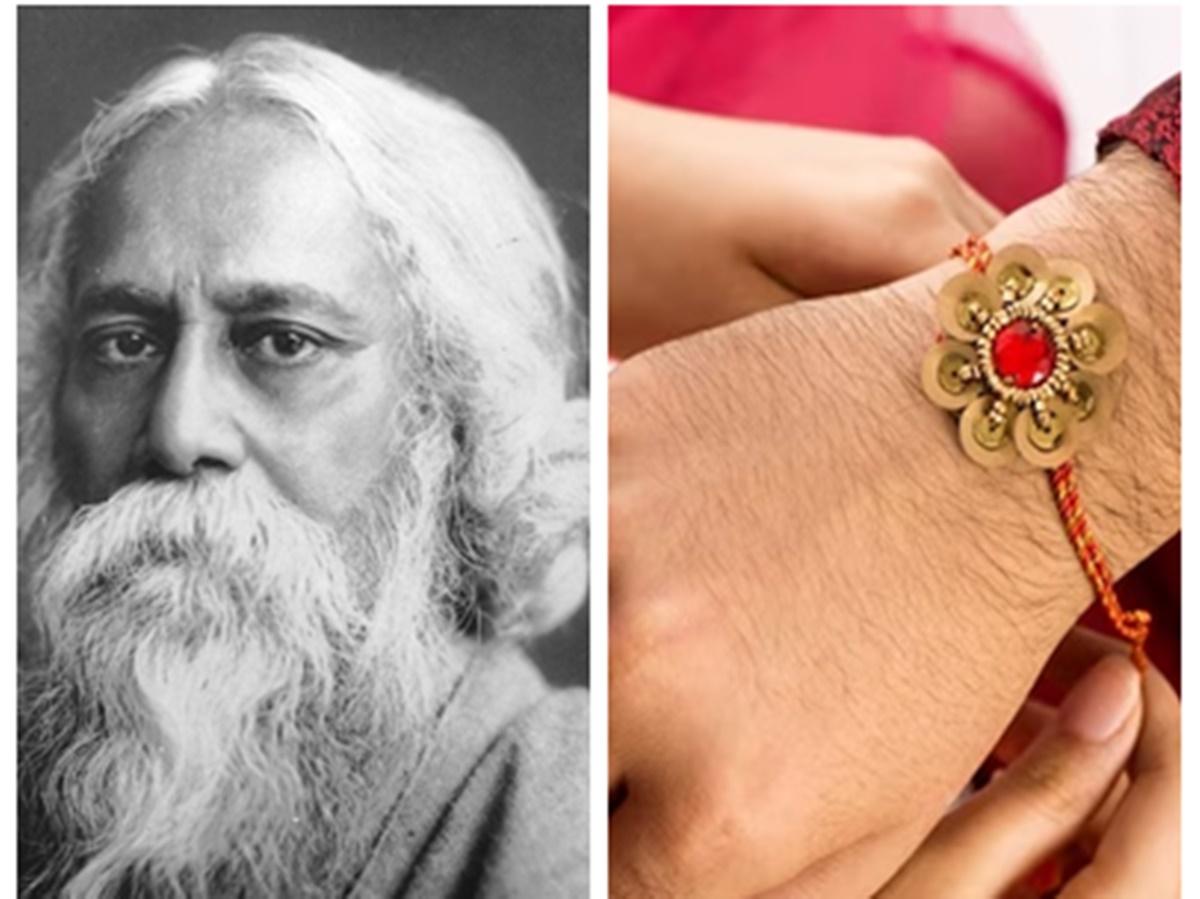
Tagore decided to transform the Hindu festival of Raksha Bandhan into a symbol of political resistance. Traditionally, during Raksha Bandhan, sisters tie a rakhi, a sacred thread, on their brothers’ wrists as a sign of love and a promise of protection. Tagore expanded the meaning of the festival. He called upon Hindus and Muslims to tie rakhis to one another, not just as a family tradition but as a public pledge to protect each other’s communities from any threat, including the British attempt to divide them.
On October 16, 1905, the day the partition of Bengal officially came into effect, Tagore and thousands of people took to the streets. It was not a violent protest but a peaceful yet powerful demonstration. Men and women moved through Calcutta, singing patriotic songs, many written by Tagore himself, such as Banglar Mati Banglar Jol (“The Soil of Bengal, the Water of Bengal”). Hindus tied rakhis to Muslims, Muslims tied rakhis to Hindus, and everyone joined in a common pledge of unity. The streets turned into a celebration of solidarity, but the underlying message was sharp and clear: Bengal would not be divided in spirit, no matter what the British decreed.
Tagore himself walked among the crowds, personally tying rakhis to people from all walks of life. The atmosphere was charged with emotion—some cried, some shouted slogans for unity, and some raised their voices against the British government’s divisive politics. This Raksha Bandhan movement spread to other towns and villages, inspiring people to resist the British plan in creative ways. It was a reminder that political struggle was not only about boycotts and petitions but also about building unbreakable human bonds.
The movement fed into the larger Swadeshi campaign, which encouraged Indians to boycott British goods and promote local industry. Although the partition went ahead, the unity shown during the Raksha Bandhan protest had lasting effects. It strengthened the nationalist spirit, brought women into public protests in greater numbers, and made it harder for the British to justify their communal policies. In 1911, just six years later, the British were forced to reverse their decision and reunite Bengal—a political victory in which Tagore’s movement played a significant role.
Rabindranath Tagore’s Raksha Bandhan revolution remains one of the most remarkable examples of how culture, tradition, and creativity can be turned into weapons of political resistance. A simple thread, usually exchanged between siblings, became a chain of unity strong enough to challenge the power of the British Empire. It was a moment in history when poetry met politics, and when a festival of love became a festival of freedom.