.jpg)
A political storm has intensified within the Aam Aadmi Party after Rajya Sabha MP Raghav Chadha publicly reacted to his removal as the party’s Deputy Leader in the Upper House, saying he may have been “silenced, but not defeated.”
In a video message, Chadha questioned whether raising public issues in Parliament had become a “crime,” alleging that the party had even approached the Rajya Sabha Secretariat to restrict his speaking opportunities. He maintained that his speeches were always focused on issues affecting common citizens and asked why anyone would want to limit his voice. “Whenever I got a chance to speak in Parliament, I raised public issues… but is raising public issues a crime?” he said, adding that public support had strengthened his resolve.
In a veiled warning to the leadership, Chadha remarked, “Do not mistake my silence for defeat. I am a river that can turn into a flood,” a statement widely seen as directed at party chief Arvind Kejriwal.
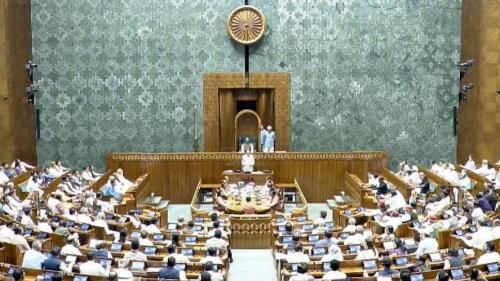
The controversy began after AAP formally wrote to the Rajya Sabha Secretariat replacing Chadha with Ashok Kumar Mittal as Deputy Leader. The party described the move as part of internal adjustments ahead of upcoming parliamentary sessions. Chadha’s removal has drawn attention given his prominence within the party and his proximity to the leadership in the past.
Responding to Chadha’s remarks, AAP leaders have strongly defended the party’s stance and questioned his recent political approach. Senior leader Saurabh Bhardwaj accused Chadha of avoiding direct confrontation with Prime Minister Narendra Modi and the BJP. He alleged that Chadha had not raised key issues in Parliament, including matters related to party workers and political developments, and criticised what he described as a “soft approach.”
Bhardwaj also pointed out that AAP, being a smaller party, gets limited time to speak in Parliament and must prioritise major national issues. He claimed that Chadha had not participated in certain opposition actions, including walkouts and signing key resolutions, and questioned his absence during critical political moments.
The developments indicate growing internal friction within AAP, with both sides presenting contrasting narratives—Chadha positioning himself as a voice for public issues, while the party leadership stresses discipline and political strategy.
With AAP holding 10 seats in the Rajya Sabha, including members from Punjab and Delhi, the leadership reshuffle comes at a crucial time ahead of upcoming parliamentary sessions. The situation is being closely watched as it could have implications for the party’s internal cohesion and public image.