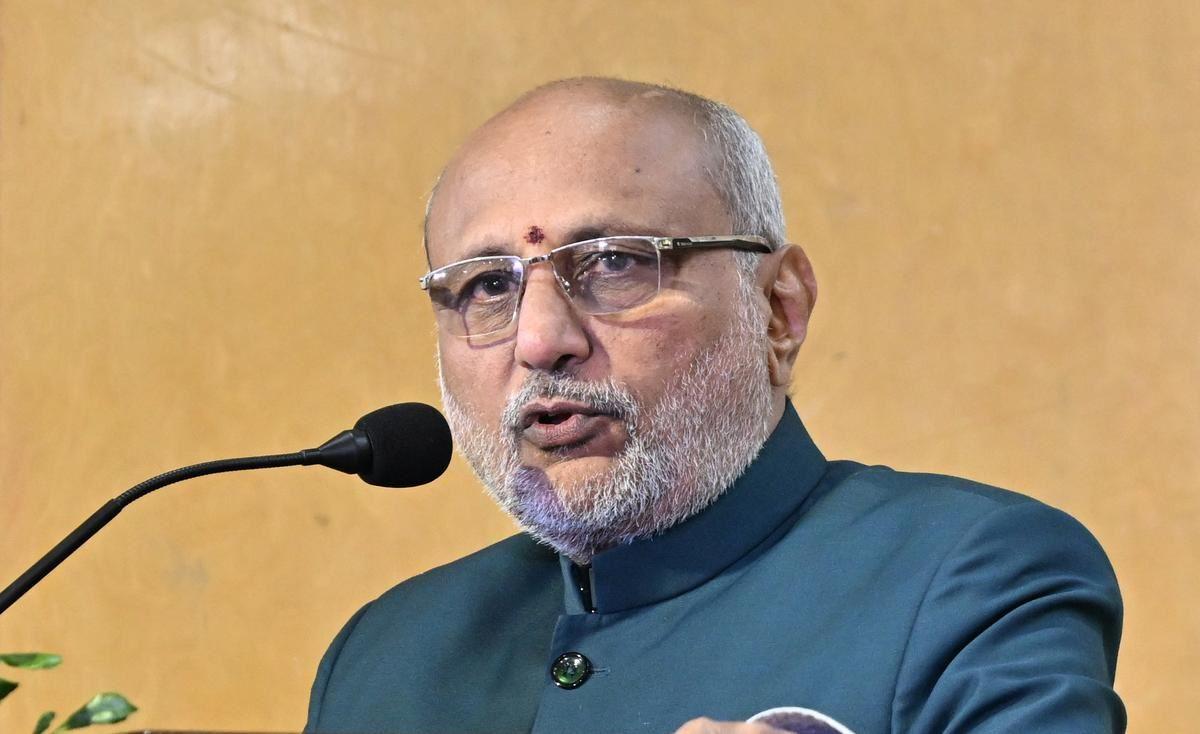
When the BJP-led NDA announced Maharashtra Governor CP Radhakrishnan as its Vice Presidential nominee, many saw it as just another routine political decision. But in reality, this choice runs far deeper than filling a constitutional post. It is a calculated political move that signals the BJP’s determination to reclaim lost ground in South India, strengthen its OBC outreach, and send a message of inclusivity ahead of future battles. By elevating Radhakrishnan — a veteran leader from Tamil Nadu with strong RSS roots and a track record of grassroots politics — the BJP has chosen not just a candidate, but a symbol of its broader strategy to expand influence in a region that has long resisted saffron consolidation.
The Vice Presidency in India is not just symbolic. The office serves as the Chairman of the Rajya Sabha, where government legislation often faces the toughest roadblocks. With the Modi government seeking to push through major reforms in its third term, a presiding officer who enjoys cross-party respect and maintains a clean, neutral image becomes crucial. This is where CP Radhakrishnan fits in.
The Man Behind the Nomination
Born in Tiruppur, Tamil Nadu, in 1957, Radhakrishnan represents a rare breed of southern leaders who have managed to stay relevant in the BJP despite the party’s limited electoral success in the state. His career began in the 1970s with the Rashtriya Swayamsevak Sangh (RSS), later transitioning into politics through the Bharatiya Jan Sangh. He went on to become the state BJP president from 2004 to 2007 and is remembered for his massive 19,000 km “Ratha Yatra” across Tamil Nadu to champion river-linking projects and caste reform debates.
Twice elected as a Member of Parliament from Coimbatore in the late 1990s, Radhakrishnan is among the very few BJP politicians from Tamil Nadu who could deliver victories in a state otherwise dominated by Dravidian parties. He later moved into administrative roles, serving as chairman of the Coir Board, and more recently as Governor of Jharkhand and Maharashtra, besides holding additional charges of Telangana and Puducherry.
What makes him stand out is his cordial image—respected by allies and even by opponents. In Maharashtra, he was known for handling sensitive political situations without controversy. Leaders across party lines, from Eknath Shinde and Devendra Fadnavis to opposition figures, have acknowledged his fairness. This reputation makes him a safe, non-divisive choice for the Vice President’s chair.
Symbolism: Reaching South, Reaching Backward Classes
The BJP has long struggled in Tamil Nadu, where Dravidian politics has overshadowed national parties for decades. By elevating Radhakrishnan, the NDA signals that it is not giving up on the south. His identity as a leader from the Gounder community, a prominent OBC group, further strengthens the BJP’s narrative of backward-class empowerment. In a political climate where caste representation plays a decisive role, the nomination serves both symbolic and practical purposes.
It is also worth noting that it has been nearly four decades since a Tamilian held the Vice Presidency—R. Venkataraman being the last, from 1984 to 1987. The move therefore carries a strong message of regional recognition. For the BJP, this could help soften its image in the southern states, particularly at a time when it is eyeing long-term expansion beyond its Hindi heartland strongholds.
A Contrast With Dhankhar’s Tenure
The election was triggered by the resignation of Jagdeep Dhankhar, who cited health reasons for stepping down. Dhankhar’s tenure was marked by frequent clashes with the opposition benches in the Rajya Sabha, often leading to acrimonious sessions. By contrast, Radhakrishnan’s non-confrontational style is expected to bring a measure of calm to the Upper House. His reputation for consensus-building might prove invaluable in a chamber where the ruling coalition does not always enjoy a comfortable majority.
The Opposition’s Dilemma
For the opposition, the question now is whether to field a candidate against him or accept a consensus choice. On one hand, contesting would allow the INDIA bloc to signal resistance to the BJP’s political dominance. On the other, opposing a candidate with such a clean, non-controversial image could backfire. If they abstain, it will project the NDA’s nominee as a widely accepted national figure. If they contest and lose—which is almost certain given the NDA’s parliamentary numbers—it could expose divisions within their ranks.
A Calculated Move for the Future
In many ways, the Vice Presidential nomination of CP Radhakrishnan is more than a constitutional formality. It is a political statement. For the NDA, it represents outreach to southern India, an assertion of OBC inclusion, and a tactical step toward ensuring smoother legislative functioning in Parliament. For the man himself, it is the culmination of a long career built on patience, grassroots work, and reputation for fairness.
The election scheduled for September 9 is unlikely to spring surprises. With the NDA’s numerical strength, Radhakrishnan is almost assured of victory.