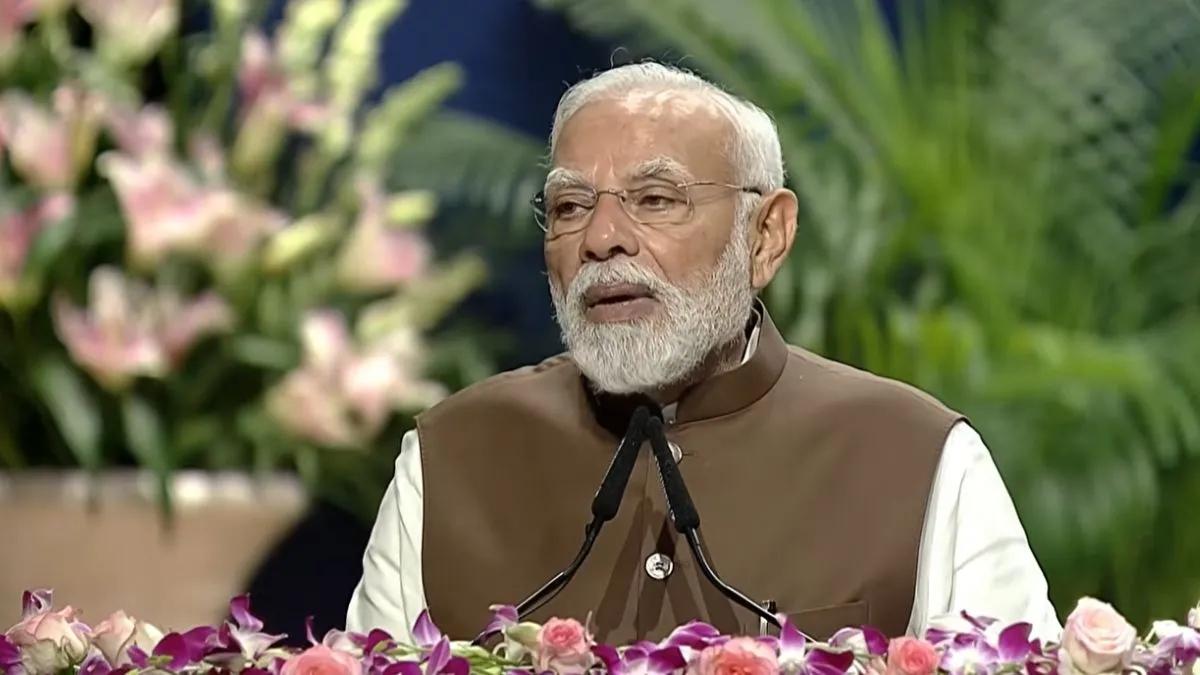
Taking a pointed dig at Congress, Prime Minister Narendra Modi on Saturday said the UPA government “ignored the agricultural sector” during its decade-long rule from 2004 to 2014. Addressing a special krishi programme at the Indian Agricultural Research Institute in New Delhi, PM Modi credited the NDA-led government with implementing “countless reforms” to strengthen farmers and make them self-reliant over the past 11 years.
“It is crucial that agriculture continues to receive government support as times change. Unfortunately, previous governments abandoned agriculture. The government lacked any vision or thought for agriculture,” he said, taking aim at Congress. “Different government departments related to agriculture operated in their own ways, leading to a continuous weakening of India's agricultural system.”
The Prime Minister highlighted the measures taken by his government to empower farmers. “We changed the previous governments' careless attitude towards agriculture. We implemented countless reforms and improvements for the benefit of all of you farmers, from seeds to the market. The results are evident today,” he added.
PM Modi also lauded recent GST reforms, saying they will further benefit farmers and the rural economy. He emphasised the government’s efforts to increase farmers’ incomes and reduce production costs, noting, “The NDA gave Rs 13 lakh crore subsidy on fertilisers in last 10 years as against Rs 5 lakh crore in 10 years of the UPA.”
Pointing to the outcomes of these reforms, the Prime Minister noted that India’s agricultural exports have nearly doubled. “Production of grains, and fruits and vegetables has also increased by nearly 90 million metric tons and 64 million metric tons, respectively, than what it was previously. India’s honey production has also doubled since 2014,” he added.
Stressing continuous improvement as key to India’s development, PM Modi said, “When the deprived are given priority and backward areas are focused on, the results are remarkable. Today, in Aspirational Districts, maternal mortality has decreased, child health has improved, and educational standards have risen.”
He concluded with a vision for the future: “Across multiple parameters, these districts are now performing better than many other districts. Based on this model, we now want to focus on developing 100 districts in agriculture that are currently lagging, so they can catch up with the more advanced districts.”